Event and activity printables sell a prepared experience: coordinated materials, understandable instructions and fewer decisions for the host. Use oddPOD to design the pages and cards, then export and test the complete printed kit. A good pack states who it is for, what the host supplies and how the activity works without the designer standing beside it.
The buyer may be planning a wedding, hosting friends or running a game night. They need to know what to print, how to prepare and what participants will do. A beautiful cover cannot answer those questions on its own.
Separate the organizer’s material from the participants’ material early. A mystery answer key should not sit beside the first clue, and a wedding production checklist belongs with the organizer rather than on a guest table. That separation makes the kit easier to explain, print and use.
Pick the experience you can prepare well.
Different kits need different kinds of testing. Plan the review around the moment where a buyer could become confused.
On a small screen, scroll the table sideways to compare the details.
| Kit | What the buyer gets | What the host supplies | Essential trial |
|---|---|---|---|
| Event stationery | Coordinated approved layouts | Names, dates and event details | Proofread and print at final size |
| Planning pack | Checklists, records and schedules | Real suppliers and decisions | Walk through the event workflow |
| Facilitated activity | Instructions, cards and response sheets | People, space and listed materials | Someone else runs it from the instructions |
| Game accessory | Original trackers or play aids | The separately obtained game | Use during an actual session |
Seven ways to turn a gathering into a product brief.
Choose one format and make the full experience understandable. Add themed editions after the underlying kit has been tested.
One visual system for the occasion
A coordinated wedding printable bundle
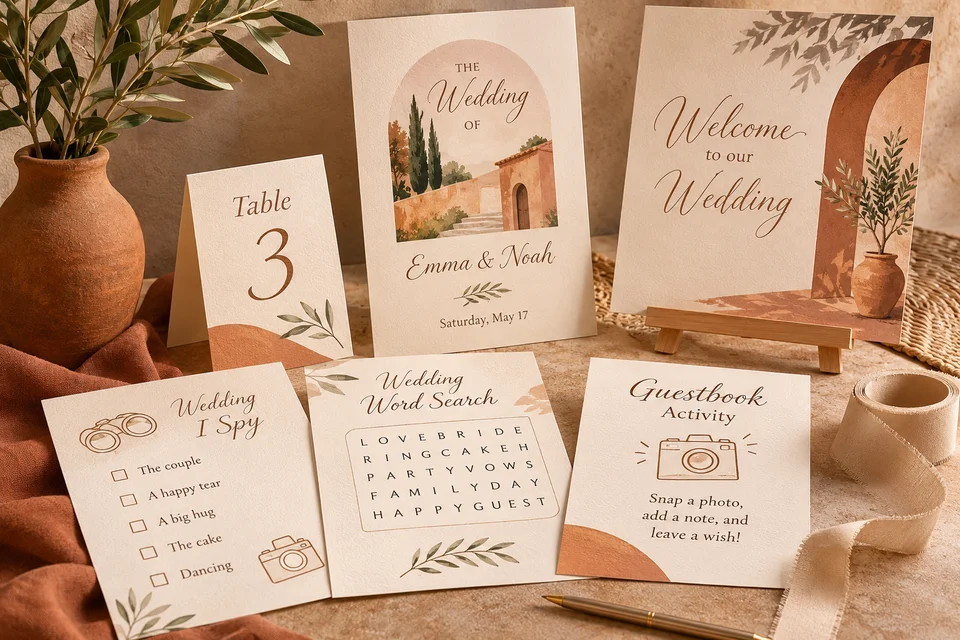
Offer a defined set such as a welcome sign, table numbers, menus and a guest activity page. Specify the dimensions and whether the files are blank, fully personalized or supplied with customer-approved wording. The buyer should be able to count the actual layouts and understand the customization process.
Define a four-piece bundle with exact sizes, one visual direction and a clear list of customer-supplied text.
How to prepare this idea
Build a consistent typography and ornament system in Studio, then adapt each piece to its reading distance. A table number and a menu should not use the same type scale simply because they share a theme. Check the exact printed size, margins and any cutting or mounting requirements.
For personalized work, collect names, dates and final text in one place and request consolidated approval. Printing, paper selection and event setup are separately arranged unless included. Do not describe the standard PDF as an editable invitation template.
Make preparation visible
An event-planning kit for a specific gathering
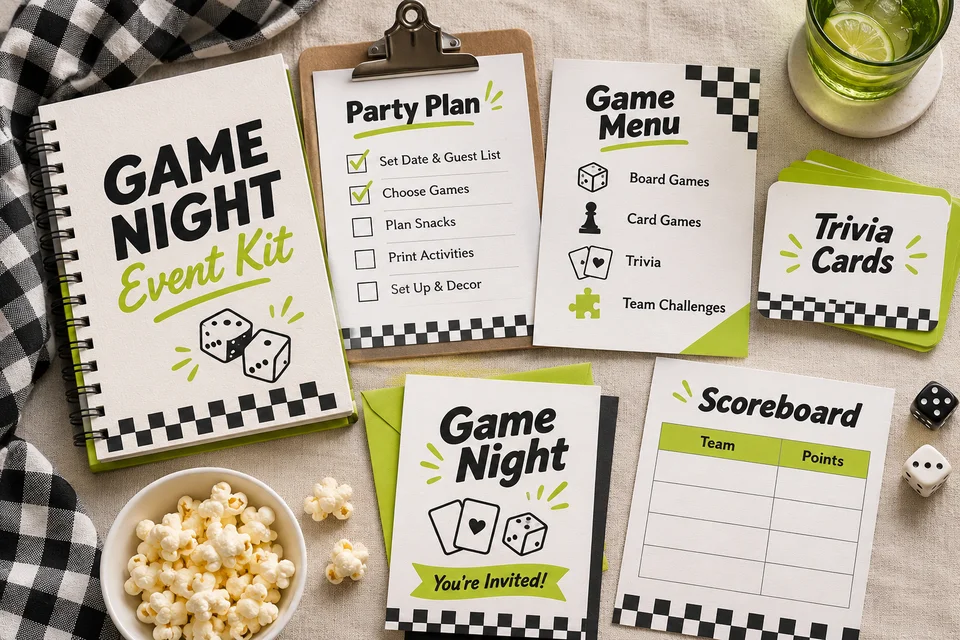
A kit for a community potluck needs different pages from a workshop or birthday gathering. Choose one event and make a supplier/contact sheet, task list, running order and materials checklist that fit it. Specificity makes the pack easier to use and describe.
Map one gathering from setup to cleanup and identify who needs each piece of information.
How to prepare this idea
Use tables and repeated labels across the pages so responsibilities and dates mean the same thing throughout. Fill the draft with a realistic event scenario to find missing handoffs. Buyers supply their own venue requirements, contacts, costs and decisions.
Keep the offer about organization. The PDF does not book suppliers, coordinate guests or send reminders. If you provide event-specific customization, make the fact-checking and revision process part of the scope.
A shared activity with a simple setup
A screen-free date-night activity pack
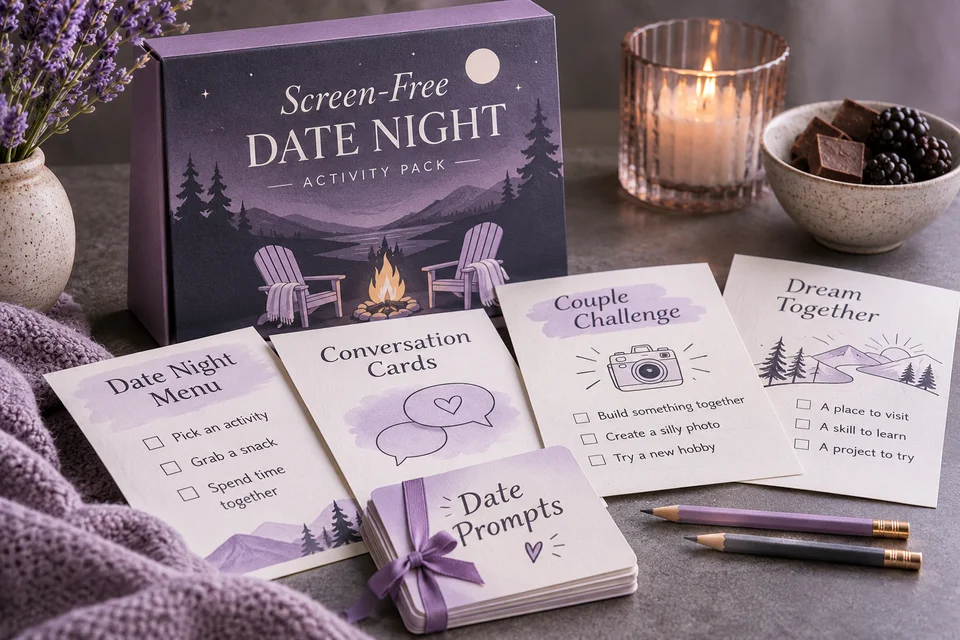
Create an original drawing game, collaborative story exercise or conversation-and-activity sequence for two adults. State the supplies and allow participants to skip prompts. A clear, enjoyable structure is a more credible offer than a promise to improve a relationship.
Create one short activity with a beginning, a shared action and a clear ending, then test it without explaining it aloud.
How to prepare this idea
Build the instructions, prompt cards and any response pages as a coordinated set. Test the flow with willing participants and note where they need clarification or feel rushed. Keep suggested timing provisional until you have tried the actual sequence.
Show a representative activity in the listing so buyers understand the tone. Explain whether they need scissors, pens, separate paper or advance preparation. The printable purchase supplies the files, not a hosted session or ongoing support.
Make every clue lead somewhere
An original printable mystery game
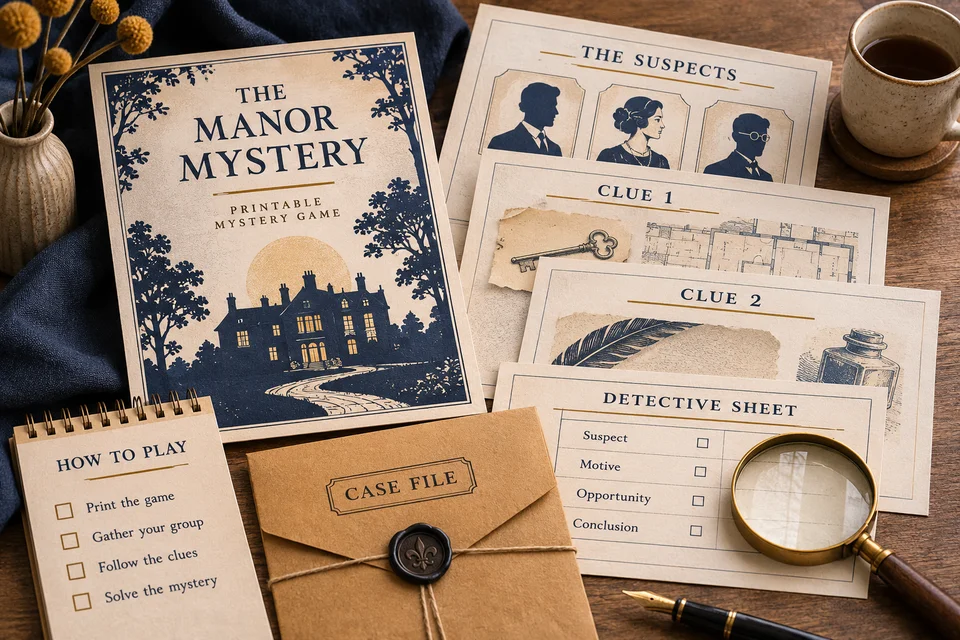
Write a small original mystery with a consistent solution, clue cards and a host guide. Decide whether it is cooperative, role-based or a sequence of puzzles before designing the pages. The buyer needs to know the intended group, preparation and materials.
Write the solution in one sentence and work backward to three clues that uniquely support it.
How to prepare this idea
Create a solution map first: every required clue, what it reveals and how the player reaches the conclusion. In Studio, make the clue hierarchy and document labels clear. Keep spoiler material in a separate host file or unmistakably separated section.
Playtest with people who have not seen the solution. Record dead ends, unintended answers and places where the host has to improvise. oddPOD can help design and package the printable materials; it does not validate the puzzle logic or run the game.
Make the activity fit the actual place
A neighborhood or garden scavenger hunt
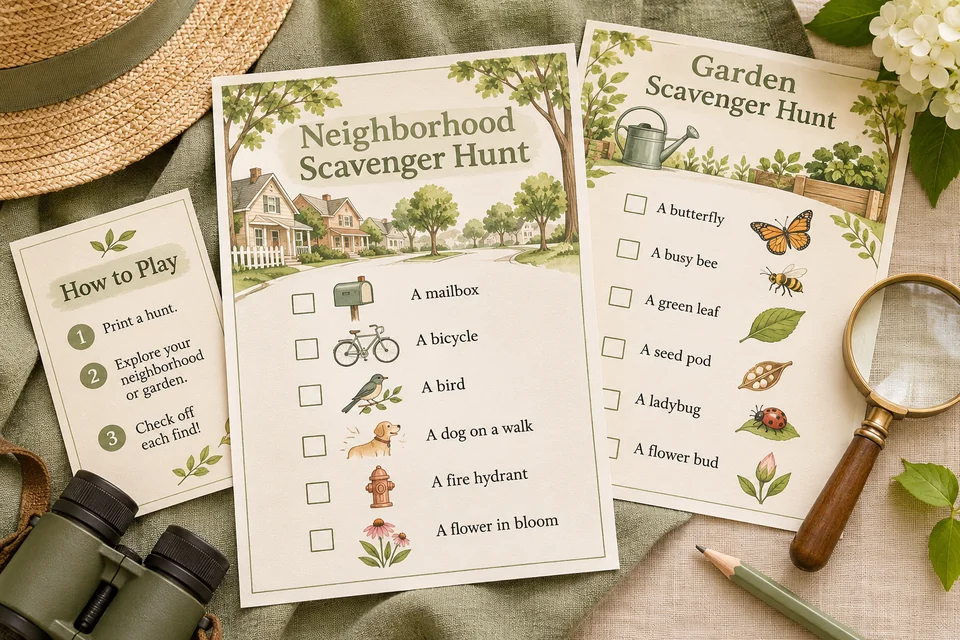
A host can use a printable observation hunt for a garden, neighborhood gathering or community space. Original prompts might ask participants to notice a texture, sketch a shape or find a host-placed symbol. Specify whether the kit is an observation activity or a route with physical clues.
Choose a small approved area and test five observation prompts there before expanding the hunt.
How to prepare this idea
Design clear participant sheets and a host setup checklist. The host needs to verify the location, access, supervision and suitability for their group. Avoid instructions that rely on entering private property or collecting unknown plants and objects.
Test the route or activity in the intended setting. If a kit is sold for general use, include a host adaptation step rather than pretending every location has the same features. Provide a paper-based alternative when an activity would otherwise require a phone.
Support the table without replacing the game
Original tabletop role-playing accessories
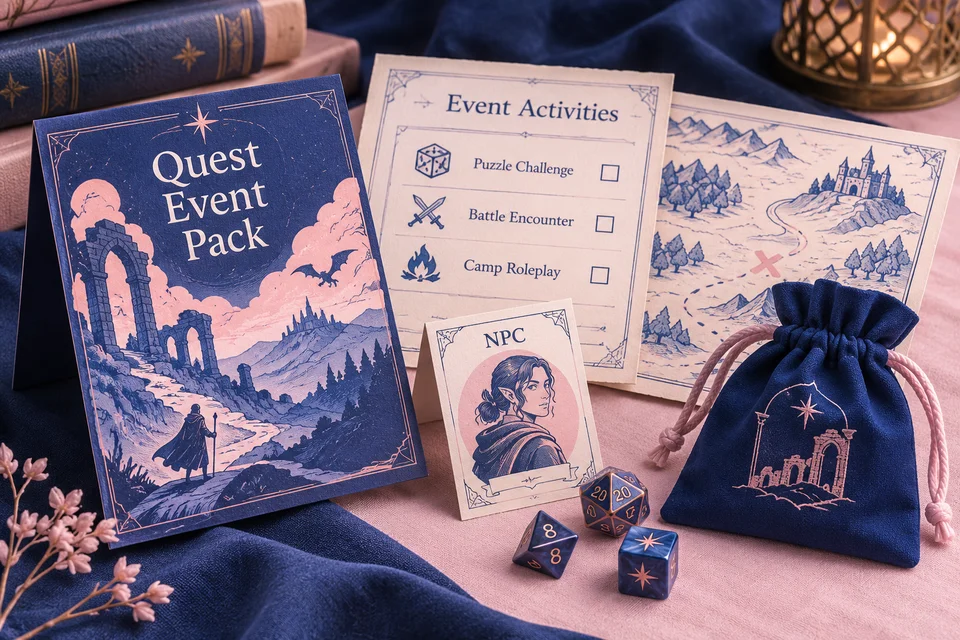
Create system-neutral session notes, location cards, character relationship maps or campaign journals. These can help a group remember what happened and prepare for the next session. Keep the product’s purpose explicit: a record and creative aid, not necessarily a complete rules system.
Design one system-neutral session recap with people, places, unresolved questions and the next planned action.
How to prepare this idea
Use your own artwork, wording and layouts. If you refer to a particular game or use its material, verify the permission and requirements for that use. A generic fantasy theme does not justify copying character sheets, rules text or recognizable artwork.
Test the accessory during a real session. Check whether the information can be recorded quickly and found later. Avoid crowding the page with fields that only make sense for an unstated rule set.
Keep the evening organized
Board-game scorekeeping and game-night packs
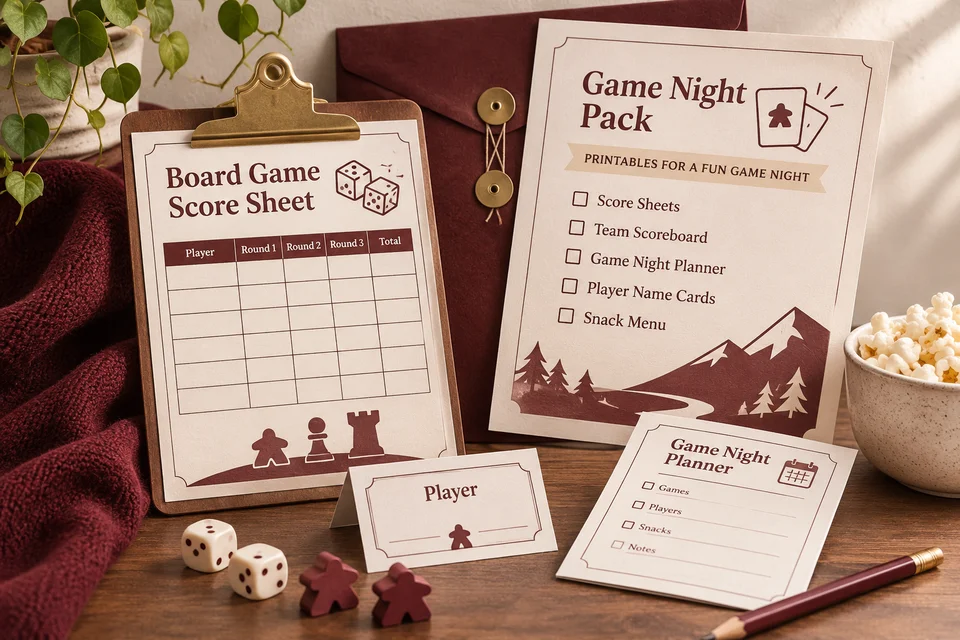
Offer a general game-night record, tournament bracket or original scorekeeping sheet for a clearly defined scoring format. A host may want player names, round results and a final summary in one consistent pack.
Run one complete sample game night through the draft and check that a new host can follow the record without extra explanation.
How to prepare this idea
Test every row, total and tie-handling instruction with realistic sample results. A printed table records scores; it does not calculate them. If a sheet is intended for a specific game, verify that the design, terminology and any stated compatibility are appropriate for your use.
Package the files with a quick-start example and show the actual number of players or rounds supported. Avoid implying that the game itself, its rules or physical components are included when you are selling an accessory.
The Garden Gathering: an original observation activity kit
This fictional kit combines a host guide, participant page and prompt cards. The illustrations are editorial concepts. The activity still needs a real print trial and a supervised run before being offered as a tested product.
A little
discovery.HOST GUIDE + ACTIVITY CARDS
Sketch a repeating shape you can see.
ORIGINAL PAGE LAYOUT- Define the shared activity
The concept is a small-group gathering where participants notice and describe their surroundings. It is an observation activity, not a timed race or a plant-identification test. The host selects a suitable area and checks the needs of the actual participants.
- Write the instructions first
The host guide explains preparation, materials, boundaries and how to finish. Original prompts include ‘Sketch a repeating shape’ and ‘Describe two different textures you can see.’ Each prompt tells the participant what to record, without requiring them to pick up or touch an unknown object.
- Build separate host and participant pages
Plan five PDF pages: one host guide, one participant observation sheet, two pages containing six prompt cards in total, and one closing reflection page. Use the same card numbers in the host guide and printable sheets. Keep cutting guides clear of the artwork and text.
- Run the complete paper experience
Print the actual export, cut the cards and ask another host to run the activity from the guide. Check whether the prompts work in the setting, participants understand the response sheet and the ending feels clear. Record any suggested group-size or timing claims only after trying them.
- Package without hidden preparation
List the five pages, six cards, paper size and supplies in the product description. Include a photo or faithful preview of the real printed layout once tested. Explain the host’s adaptation role and deliver the approved PDF files through the chosen shop.
The delivery plan
What the finished work should include.
- A host guide with preparation, materials and a clear ending.
- One participant observation page and six original prompt cards.
- A closing reflection page and print/cut instructions.
- A reviewed PDF with host-only information clearly identified.
- A record of the trial, revisions and the claims it actually supports.
A seasonal edition should change the activity in a useful way. Recheck the prompts and setting rather than only swapping the colors and cover title.
Test it with someone who has not read your mind.
The most revealing trial is a host working from the files you intend to deliver. Watch for missing instructions, accidental spoilers, unclear preparation and layouts that are difficult to cut or read. Include writing, playtesting and revision time in the cost of developing the product.
- State the intended participants, setup and required supplies.
- Separate host instructions, participant materials and any solutions.
- Use original or authorized artwork, stories and game material.
- Print and assemble every component from the final export.
- Check puzzle logic, score fields and instructions with realistic use.
- Describe tested limits honestly and make customization requirements explicit.
Further reading and destination guidance.
An example of a place-aware observation activity. Develop original prompts and review the setting for your own kit rather than copying the museum’s materials. Natural History Museum: a Jurassic scavenger hunt →
Your questions, answered.
Can oddPOD generate and validate a complete mystery game?
You can use its design tools and optional paid AI assistance while developing the material. You remain responsible for the story, clue logic, answers and playtesting. A generated or visually complete kit is not automatically a playable game.
Are these editable event templates for the buyer?
This guide describes final print-and-write PDFs and separately scoped personalized orders. Editable Studio artboards are your working files. Advertise buyer-editable templates only if you have separately created and verified that deliverable.
How should I separate instructions from spoilers?
Use clearly named host and participant files, or an unmistakably separated host section. Include a contents list and tell the buyer which pages to print for participants. Test the delivery package with someone who has not seen the solution.
Can I sell accessories for an existing game?
Develop original material and verify the permissions and requirements for any game-specific content, names or compatibility statements. A system-neutral notebook is a different offer from a licensed or game-specific accessory.
Do I need professional printing?
That depends on the product you promise. Test ordinary home printing if the kit is sold for home use. If a sign or card requires a particular size, stock or print service, explain that before purchase and check a suitable proof.